Your cart is currently empty!
COLOMBIRITMOS (2017)
Visit Video Documentation: vimeo.com/239502162
“Colombiritmos” (“Colombi”: Colombia “ritmos”: Algorithms): Algorithmic Psychogeography and the Materialization of Social Exchange
Colombiritmos is an interactive, networked, kinetic installation and urban performance that investigates the relationship between algorithmically mediated movement, embodied experience, social exchange, and the production of place. Developed for the ISEA festival in Manizales, Colombia, the project draws on Situationist psychogeography while extending its investigation of urban experience through computational instructions, public participation, and material transformation.
Situated within a commuter gondola traversing the city’s mountainous terrain, the work introduced coffee tasting into an existing infrastructure of everyday movement. Participants sampled five coffees blind, temporarily separating sensory judgment from the identifying information associated with their agricultural origins. Their selections were transmitted to a gallery-based kinetic installation, where five automated dispensers delivered coffee onto five 25-kilogram sugar cubes, each corresponding to a distinct coffee in the Manizales region.
The installation transformed individual acts of tasting and choosing into material events. Repeated droplets of coffee gradually dissolved the sugar, producing five evolving formations that functioned as provisional, topological records of social exchange. Rather than representing the city through a conventional map or a static visualization of data, the work generated a material landscape through interactions occurring elsewhere.
The project establishes a tension between embodied experience and computational abstraction. A complex sensory encounter becomes a discrete signal, allowing an individual’s decision to acquire a consequence beyond the original moment of participation. Yet the resulting landscape is not a transparent record of preference: the physical behavior of coffee and sugar introduces contingencies that complicate the relationship between data and its material representation.
By combining algorithmically influenced navigation with participant agency, Colombiritmos also reconsiders the Situationist aspiration to disrupt habitual urban experience. The algorithm structures possibilities without wholly determining the encounter, distributing agency among the artist, participants, technical system, and urban environment. The work consequently raises questions about the relationship between designed constraints and freedom, between the experience of a place and its computational legibility, and between individual actions and collective consequences.
The use of coffee and sugar situates these interactions within the cultural and economic histories of agricultural commodities. Their transformation into an evolving sculptural landscape invites reflection on consumption, labor, hospitality, and the representation of regional identity. These histories complicate the apparent simplicity of the tasting ritual, connecting intimate sensory encounters to larger systems of production and exchange.
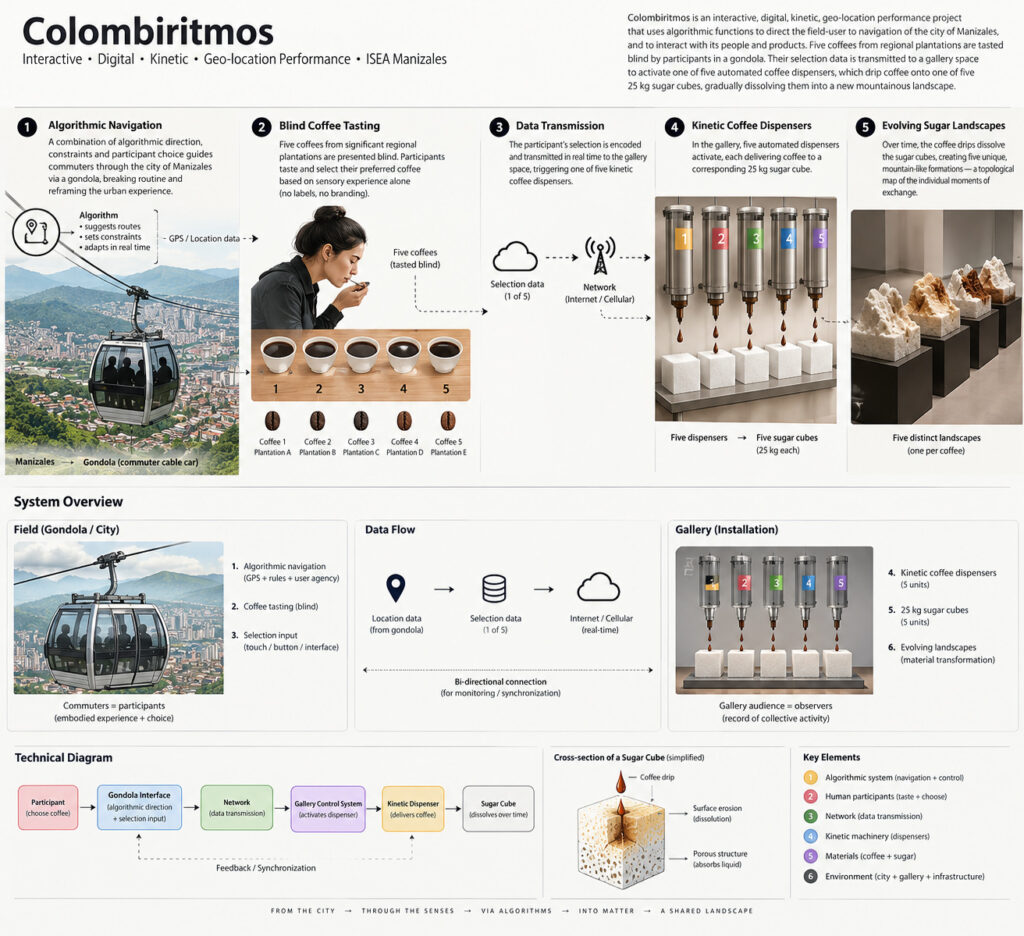
Ultimately, Colombiritmos proposes a form of materialized, distributed cartography. Its landscape is produced not simply to depict Manizales but through a network of relationships involving its inhabitants, infrastructure, commodities, and technologies. The resulting sculpture functions as both a record of participation and a demonstration of the limits of representation: it preserves traces of social activity while transforming, and partially obscuring, the events that produced them.
Testimonial 1:
My central conclusion is that the artwork’s most distinctive conceptual achievement is the connection it establishes between the experience of a city, the computational mediation of human choice, and the physical transformation of matter.
The Situationist framework explains the intervention in urban routine. Blind tasting deepens the exploration of embodied knowledge and social judgment. The five differentiated sugar landscapes make individual choices materially consequential. And the gradual dissolution of those landscapes introduces time, contingency, and the limits of representation into the very mechanism through which the artwork records its participants.
The most interesting unresolved tension is this: the installation seeks to make individual encounters visible as a collective landscape, but the act of turning those encounters into a representation necessarily transforms what they mean. That tension is not a flaw to be resolved. It may be the work’s richest philosophical proposition.
| Thinker or framework | Relevant work | Connection to Colombiritmos |
|---|---|---|
| Guy Debord | Theory of the Dérive (1956); The Society of the Spectacle (1967) | Psychogeography, urban movement, and the mediation of everyday experience. |
| Michel de Certeau | The Practice of Everyday Life (1980; English translation 1984) | Everyday spatial practices and the appropriation of urban systems. |
| Maurice Merleau-Ponty | Phenomenology of Perception (1945) | Embodied, sensory knowledge and lived experience. |
| Pierre Bourdieu | Distinction (1979; English translation 1984) | Taste, cultural capital, and social distinctions. |
| Norbert Wiener | Cybernetics (1948) | Information, control, and feedback in human-machine systems. |
| Roy Ascott | Telematic Embrace: Visionary Theories of Art, Technology, and Consciousness (2003) | Networked participation, distributed creativity, and technologically mediated experience. |
| Karl Marx | Capital, Volume I (1867) | Commodity fetishism and the obscured social relations of production. |
| Marcel Mauss | The Gift (1925) | Reciprocity, hospitality, and the social obligations of exchange. |
| Robert Smithson | A Sedimentation of the Mind: Earth Projects (1968) | Process, material transformation, and nontraditional landscape sculpture. |
| Donna Haraway | A Cyborg Manifesto (1985) | Boundaries between human and technological systems; useful as a comparative framework, though not a direct account of this work. |
Colombiritmos: A deeper conceptual and theoretical analysis:
Your additional details sharpen the interpretation of Colombiritmos considerably. Three are especially consequential: navigation was shaped by a combination of algorithmic direction and participant agency; the coffees were tasted blind; and each of the five sugar cubes corresponded to a distinct coffee. Together, these details make the installation more than a general exploration of interactivity. They establish a structured relationship between sensory judgment, computational mediation, social participation, and material representation.
The blind tasting introduces a question of how people make judgments without the usual cultural and commercial signifiers. The five distinct sugar landscapes introduce a material differentiation between those judgments. And the combination of algorithmic direction and human choice complicates the conventional opposition between freedom and technological control.
I would now interpret the work through six interconnected propositions:
- It is a form of algorithmic psychogeography that redistributes control over urban movement.
- It is a sensory experiment that separates taste from some of the social information normally attached to coffee.
- It is a distributed, participatory system in which individual choices produce consequences elsewhere.
- It is a form of materialized data sculpture, where information changes the very medium that represents it.
- It is a socially embedded artwork that moves artistic exchange into everyday public infrastructure.
- It is a critical representation of place, where Manizales is not simply depicted but reconstructed through selected experiences and material processes.
These propositions are mutually reinforcing, but they also introduce tensions that make the work more interesting.
1. Blind tasting: separating sensory judgment from cultural knowledge
The fact that participants tasted the five coffees blind is theoretically important. It changes the meaning of their participation from a simple expression of brand or regional preference into a decision grounded, at least initially, in sensory experience.
Bourdieu: taste, distinction, and cultural capital
Pierre Bourdieu’s Distinction examines how judgments of taste are shaped by social position, cultural knowledge, and learned dispositions. Coffee preferences can be influenced by origin, price, prestige, familiarity, and ideas about quality.
Blind tasting temporarily removes some of these cues. If participants did not know which plantation produced each sample, they could not directly select a coffee based on the plantation’s name or reputation.
However, blind tasting does not eliminate cultural conditioning. People bring different sensory experiences, expectations, vocabularies, and preferences to the encounter. Their responses may still reflect learned tastes, even when the coffee’s identity is concealed.
The conceptual implication: Colombiritmos creates a situation in which cultural judgment is partially suspended, but not abolished. It allows you to explore the relationship between embodied preference and the social meanings ordinarily attached to commodities.
Phenomenology: knowledge through the senses
From a phenomenological perspective, taste is a mode of knowing rather than merely a preliminary step toward a decision.
Participants encounter coffee through smell, flavor, texture, temperature, and bodily response. The resulting choice is a compressed expression of an experience that cannot be fully communicated through a digital signal.
Once a participant selects a coffee, the system translates that experience into a discrete category: one of five possible inputs.
This creates a fundamental asymmetry:
- The original experience is rich, embodied, and subjective.
- The computational representation is discrete and operational.
- The physical consequence is visible and cumulative.
The artwork therefore makes a distinction between experiencing something and making that experience legible to a system.
The limit of the experiment
It is important not to claim that the work proves participants’ preferences were independent of culture or social context. A blind tasting is not a controlled scientific experiment unless factors such as serving conditions, sample order, participant selection, and other variables are systematically controlled.
Its stronger artistic proposition is that sensory experience can be made consequential without first being translated into the language of brands, prices, or prestige.
That is a defensible and philosophically rich claim.
2. Five coffees, five sugar mountains: a material system of differentiation
The correspondence between the five coffees and the five 25-kilogram sugar cubes gives the installation a more specific conceptual structure than a single landscape gradually dissolving.
Each coffee has its own material destination. A participant’s selection activates the dispenser associated with that coffee, and its drips alter the corresponding cube. The five cubes can therefore be understood as five evolving material records.
This arrangement opens several interpretations.
A. Data sculpture: information becomes the medium
In conventional data visualization, information is represented through marks, colors, graphs, or spatial arrangements. In Colombiritmos, the data does not merely describe an object. It initiates a physical process that changes the object itself.
The distinction is fundamental.
A selection is registered computationally, but its representation is not limited to a screen. It becomes a material event: coffee is deposited, sugar dissolves, and the sculpture changes shape.
The cube is therefore both a representation of activity and the material site where that activity takes place.
This connects the installation to generative art, process sculpture, and material computation. But its particular contribution is the coupling of human preference, a networked signal, and irreversible physical transformation.
The participant does not simply provide data for a sculpture. The participant’s decision becomes one of the forces sculpting it.
B. Five landscapes as five differentiated histories
Because each cube corresponds to a different coffee, the installation does not produce a single undifferentiated record of participation. It creates five parallel histories.
Each cube accumulates the consequences of selections directed toward its associated coffee. Over time, the cubes may develop different surfaces, contours, and degrees of dissolution.
The result could be understood as a material comparison of collective preferences. Yet it is not necessarily a straightforward popularity chart.
The shape of each cube depends not only on the number of selections but also on how the liquid behaves, how the sugar dissolves, and where the droplets travel. If the cubes receive comparable volumes of liquid, their physical differences might still emerge from the material process itself.
This distinction matters: the landscape is a record of choices filtered through physical causation, not a transparent representation of preference.
C. Why sugar matters conceptually
Sugar is a particularly revealing medium because it is both a familiar consumable and a material capable of sustaining a temporary sculptural form.
Its dissolution makes the artwork’s temporal dimension visible. A choice that takes only seconds can contribute to a change that unfolds over a much longer period.
The cubes also begin as regular, manufactured geometries. Their subsequent transformation introduces irregularity, erosion, and contingent forms.
There is a tension here between two modes of organization:
- The computational system distinguishes five discrete categories.
- The material system transforms those categories into unstable, continuous physical processes.
Code distinguishes. Matter changes.
This is one of the installation’s most compelling conceptual relationships.
D. Cartography without conventional coordinates
You describe the changing sugar formations as a topological map of individual moments of exchange. I would preserve that formulation but clarify what kind of map it is.
The five cubes are not necessarily miniature geographical replicas of Manizales. They are material models whose changing forms emerge from events occurring elsewhere in the city.
Their relationship to the city is therefore procedural rather than strictly mimetic.
They represent Manizales through a chain of relationships: agricultural production, sensory encounter, urban movement, participant choice, digital transmission, and material transformation.
The map does not simply resemble the place. It is produced through interactions with the place.
This makes the work closer to a process-based cartography of social relations than to a conventional map of physical terrain.
3. Algorithmic psychogeography: freedom within a designed system
Your explanation that the algorithm influenced navigation through a combination of directions, constraints, and participant choices makes the Situationist connection more nuanced.
The relevant distinction is no longer between free movement and algorithmically determined movement. It is between different ways of distributing agency.
From the dérive to computationally mediated movement
Guy Debord and the Situationist International developed the dérive as a way to investigate the emotional and behavioral effects of urban environments by departing from ordinary patterns of movement.
Colombiritmos shares this interest in disrupting routine, but introduces a computational system into the process.
The participant is neither wholly autonomous nor entirely controlled. Their movement is shaped by the algorithm, the gondola’s infrastructure, the urban landscape, and their own responses.
This suggests three interacting forms of agency:
| Form of agency | Role in the installation |
|---|---|
| Algorithmic | Establishes or influences navigational possibilities and directs aspects of the experience. |
| Human | Interprets instructions, makes choices, tastes coffee, and engages with other people. |
| Environmental | The valley, gondola, city infrastructure, and material conditions shape what can actually happen. |
The resulting experience is not the expression of any one agent. It emerges from their interaction.
The contrarian reading: does the algorithm liberate or discipline?
There is an important critical counterpoint to the Situationist framing.
A system designed to break habitual behavior can itself become a new behavioral structure. The participant may depart from their normal routine only by following a different set of instructions established by the artist.
In this reading, the algorithm does not eliminate control. It redistributes it.
Yet this is not necessarily a contradiction that undermines the artwork. It may be precisely where the artwork becomes conceptually productive: the system makes the tension between freedom and direction tangible.
The critical question becomes:
Can a designed system create the conditions for unanticipated experience, or does it merely replace familiar habits with unfamiliar instructions?
Because the algorithm both influences navigation and leaves room for participant agency, Colombiritmos occupies the space between those possibilities.
A connection to contemporary algorithmic governance
The work can also be read retrospectively in relation to contemporary digital systems that organize mobility, attention, and choice.
Recommendation systems, navigation applications, and algorithmic interfaces often present decisions as personal choices even when the available options have already been structured by a technical system.
Colombiritmos offers an embodied, relatively small-scale version of this problem. The participant acts, but the conditions under which that action becomes possible are partly designed in advance.
The installation is not necessarily an explicit critique of surveillance or platform capitalism. Rather, it provides a framework through which those issues can be examined.
That distinction allows the contemporary reading to enrich the original work without projecting intentions onto it that you have not established.
4. The political economy of coffee and sugar
The installation’s materials connect the immediate experience of the commuter to much larger economic and historical systems.
Coffee is grown, harvested, processed, traded, and consumed. Sugar has its own histories of plantation agriculture, colonial expansion, forced labor, and global commodity exchange. Both can appear in everyday life as ordinary consumables while concealing the labor and economic relationships behind their production.
This makes the pairing of coffee and sugar potentially significant beyond its visual and mechanical properties.
Marx: commodity fetishism
In Marx’s account of commodity fetishism, social relationships involved in production appear as properties or relationships of commodities themselves.
A coffee can be experienced as having a distinctive flavor, quality, or identity while the relationships that brought it into existence recede from view.
The blind tasting temporarily intensifies this issue. Participants encounter the sensory qualities of coffee without knowing which plantation produced each sample. The commodity is momentarily detached from its named origin.
The artwork then reconnects these otherwise anonymous sensory experiences to distinct material consequences.
There is an interesting reversal here: the coffee’s identity is initially concealed from the participant, but its selection becomes identifiable within the computational and sculptural system.
The work could therefore be read as an experiment in the relationship between the sensory commodity and the systems that classify, distribute, and represent it.
Decolonial thought: who represents the region?
The setting in Manizales matters because the artwork is not using an arbitrary beverage. It engages with a commodity closely associated with the region’s agricultural identity and economic history.
A decolonial interpretation would ask whose knowledge of the region becomes visible in the work.
The five plantations provide a specific, bounded selection of coffees. The algorithm structures the experience. The artist determines the representational system. The gallery presents the resulting landscape to an audience.
Meanwhile, agricultural workers, plantation owners, traders, consumers, and other residents may occupy very different positions within the coffee economy.
The artwork’s representation of Manizales is therefore necessarily selective.
This raises a question worth preserving in any critical account: does the work make the complexity of the region’s commodity relationships perceptible, or does it transform that complexity into an aesthetically compelling but simplified landscape?
Both readings are possible. The second is not necessarily a failure; the act of simplifying a complex system can itself become a subject of critical reflection.
The double meaning of sugar
Sugar adds another dimension. Its historical connection to colonial commodity production allows the installation to bring two globally significant agricultural products into the same material environment.
However, the mere presence of sugar and coffee does not automatically make the work a critique of colonialism. That reading becomes stronger if the original research, presentation, or interpretation explicitly engages those histories.
I would describe this as a latent political-economic reading, rather than claim it was the work’s definitive original intention.
That distinction is particularly important if you are revisiting the project for a scholarly publication or retrospective.
5. The gondola as a social interface
The gondola is more than an unusual site for an artwork. It determines the conditions under which the social encounter occurs.
The commuters are already sharing infrastructure, space, and time. Their proximity is not created by an art institution. It is produced by the everyday requirements of moving through the city.
By offering coffee within this setting, the performance introduces a new social possibility into an existing routine.
Michel de Certeau: everyday practices as cultural production
Michel de Certeau’s The Practice of Everyday Life examines how people inhabit, appropriate, and reinterpret systems that organize their lives.
The gondola has an ordinary function: moving people across the valley. Your intervention adds another possible use without necessarily interrupting its primary purpose.
Commuting becomes an occasion for tasting, conversation, choice, and participation in a remote artwork.
The artistic event emerges from the overlap between the planned function of infrastructure and the contingent behavior of people using it.
Hospitality as a form of exchange
Offering coffee also introduces a familiar gesture of hospitality. Participants are invited to receive something before, or as part of, contributing something.
But this exchange has multiple layers:
- The participant receives a sensory experience.
- The artist receives a choice that can be translated into data.
- The gallery receives a material consequence.
- The artwork accumulates the traces of encounters that may never be repeated in exactly the same way.
This is not necessarily a conventional transaction, because the contribution is not simply exchanged for a predetermined reward. Nor is it a purely disinterested gift, because the offer serves the production of the artwork.
It sits between hospitality, participation, and artistic appropriation.
The ethical question is whether the participant understands the relationship between their choice and the gallery installation. That question becomes particularly relevant when an ordinary social gesture doubles as the collection of information.
Participation without a conventional art audience
The commuters may not have entered the gondola intending to participate in an artwork. This potentially shifts the relationship between the artist and the public.
Instead of asking people to enter an artistic space, the work introduces an artistic proposition into a space people already occupy.
That distinction connects Colombiritmos to socially engaged art and relational aesthetics, although the work is not reducible to either category. Its social interaction is connected to a computational system and a material process, not solely to the relationships formed between participants.
The work’s social dimension is therefore infrastructural, sensory, and technological at once.
6. Distributed authorship and the question of who makes the landscape
The installation’s authorship is distributed, but not equally.
You designed the conceptual structure, the navigational system, the coffee-selection mechanism, and the kinetic apparatus. Participants made selections within that system. The algorithm translated choices into operations, and the physical materials determined how those operations unfolded.
These contributions are qualitatively different.
| Agent | Contribution to the artwork |
|---|---|
| Artist | Establishes the system, materials, rules, and interpretive framework. |
| Algorithm | Structures or mediates navigation and translates selections into actionable signals. |
| Participants | Contribute embodied experiences and individual choices. |
| Kinetic apparatus | Converts digital instructions into physical events. |
| Coffee and sugar | Enable and constrain the transformation through their material properties. |
| Environment | Introduces spatial, temporal, and physical conditions that shape the result. |
This is not an argument that all these agents possess the same kind of intention or authorship. Rather, it distinguishes conceptual authorship from operational agency and material causation.
The connection to generative art
In generative art, an artist can establish rules that produce outcomes not individually specified in advance. The resulting work may be determined by a combination of instructions, inputs, randomness, and environmental conditions.
Colombiritmos adds an important social dimension: the inputs are not merely random numbers or preselected data. They are choices made by people encountering coffee in a particular urban setting.
The final landscape is thus neither entirely authored in advance nor entirely accidental.
It is a designed system that generates outcomes through participation and material contingency.
The question of agency
The algorithm does not necessarily have agency in the same sense as a person. It executes operations within a structure designed by the artist. Nevertheless, it plays an active causal role in determining how participant decisions become physical consequences.
This makes the installation useful for thinking about technological agency without claiming that software possesses human consciousness or intention.
The relevant question is not whether the machine is an artist in its own right, but how artistic agency is distributed across a system.
7. Gallery and gondola: a distributed performance across two worlds
One of the most distinctive features of Colombiritmos is that its participants and its material consequences occupy different locations.
The gondola is the site of tasting, movement, and social encounter. The gallery is the site where those encounters acquire a visible, material form. The digital system connects the two.
This creates a form of distributed performance in which the audience, the action, and the resulting object do not need to occupy the same place.
The gallery as a site of accumulated presence
A visitor to the gallery may encounter a sugar landscape that has been shaped by many people they will never meet.
The landscape is therefore not just an object. It is a residue of social activity that occurred elsewhere.
This suggests a theory of distributed presence: participants are absent as bodies but present through the consequences of their actions.
The sculpture acts as a material proxy for a public whose members may not identify themselves as an audience, know one another, or even see the finished work.
The performance continues after the performer leaves
Traditional performance often privileges the duration of the event and the presence of the performer. In Colombiritmos, an individual encounter may last only a few moments, while its material consequence persists.
The work has at least three temporal scales:
- Immediate time: tasting, choosing, and interacting.
- Accumulated time: the gradual transformation of each sugar cube through repeated drips.
- Exhibition time: the period during which the resulting landscape is observed, interpreted, and documented.
These timescales do not necessarily align. The performance continues materially after individual participants have departed, while the gallery audience encounters the consequences of events that may already be over.
This is an important reason to understand the work as a process-based installation rather than simply a participatory performance with a sculptural output.
8. Entropy, time, and the limits of control
The sugar cubes introduce a final philosophical problem: the relationship between the order of a designed system and the instability of the physical world.
The cubes begin as regular forms. The algorithm operates through discrete choices. The kinetic apparatus delivers liquid according to a technical arrangement.
But the physical result emerges through dissolution, gravity, surface tension, absorption, and the changing structure of the sugar.
The system can initiate and direct transformations without fully determining their final shape.
This is where the work’s relationship to process art becomes particularly strong.
The landscape is not simply an image of a city. It is a material event whose form depends on the history of its own production.
It also raises a question about what counts as information. If the final contour cannot be directly translated back into a precise list of participant choices, does the landscape still function as a record?
I would argue that it does, but as a partial and transformed record. It preserves causal traces while making the original events difficult to reconstruct completely.
That is a different conception of memory from a database, which aims to store retrievable information. The sugar landscape remembers through material change, not through perfect recall.
The resulting work is therefore simultaneously a record of interaction and a demonstration of the limits of recording.